Feature
Performance for endless possibilities.
Small-form-factor computing solutions are becoming more common as professionals look to minimize their desktop workstation footprint—without compromising performance. Today’s professional workflows require small-form-factor workstations to provide full-size features and performance in a compact package.
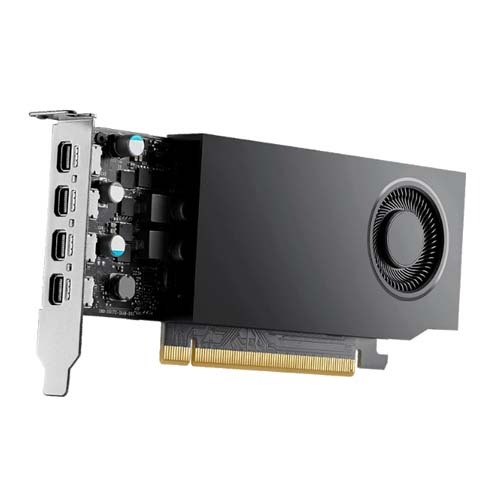
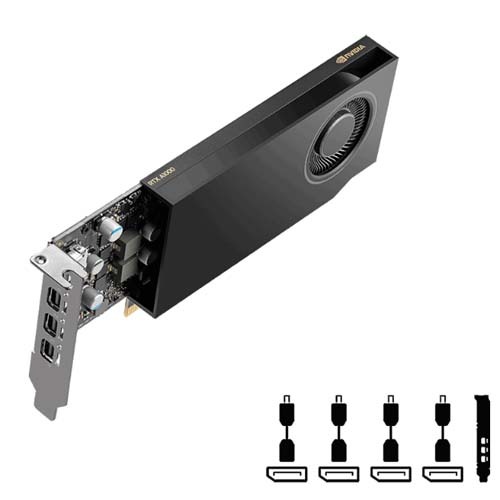
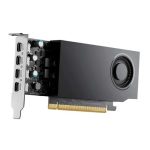
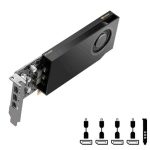
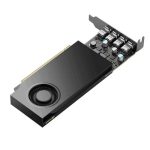
Built on NVIDIA Ampere GPU architecture, the PNY NVIDIA RTX™ A1000 GPU is a powerful, low-profile solution that delivers the performance and capabilities required by demanding professional applications. With 2,304 CUDA® Cores, 18 RT Cores, 72 Tensor Cores, 8GB of GDDR6 memory, and the ability to drive up to four 5K displays, the NVIDIA RTX A1000 is ready to take your work to the next level.
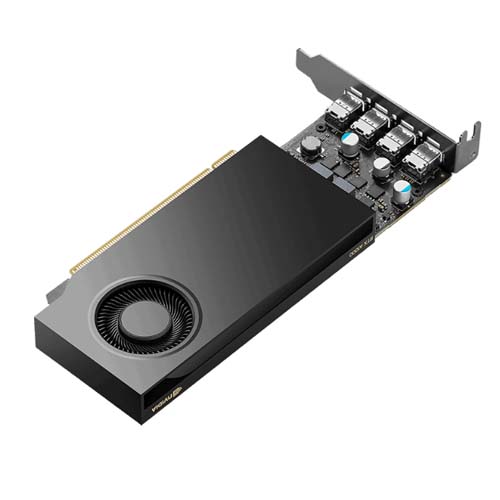
NVIDIA Ampere architecture enhances ray tracing operations, tensor matrix operations, and concurrent executions of FP32 and INT32 operations.
The NVIDIA CUDA cores bring up to 2.7x the single-precision floating point (FP32) throughput compared to the previous generation, providing significant performance improvements for graphics and rendering workflows such as 2D graphics, 3D model development, basic photo and video editing and compute for workloads such as data analysis and general productivity. RTX A1000 enables two FP32 primary data paths, doubling the peak FP32 operations.
With 2nd-Gen ray tracing engines, this graphics card renders complex models with accurate shadows, reflections, and refractions. Working with APIs like NVIDIA OptiX, Microsoft DXR, and Vulkan ray tracing, RTX A1000-based systems power interactive design workflows to boost productivity. The RTX A1000 is up to 3x faster in rendering performance compared to the previous generation and speeds up ray-traced motion blur for faster, more accurate results.
Built for modern workflows, this GPU includes enhanced Tensor Cores as part of the Ampere architecture that accelerates more datatypes and delivers up to 3x the generative AI performance compared to the previous generation. 3rd-Gen Tensor Cores will accelerate the TF32 and BFloat16 precision modes. Independent floating-point and integer data paths allow more efficient execution of workloads using a mix of computation and addressing calculations.
The RTX A1000 supports PCIe Gen 4, which provides double the bandwidth of PCIe Gen 3, improving data-transfer speeds from CPU memory for data-intensive tasks like AI and data analysis.
Equipped with 8GB GDDR6 memory and a faster memory clock, the RTX A1000 provides an ideal memory footprint to address datasets and models in latency-sensitive professional applications and at volume.
NVDEC is optimal for transcoding and video playback applications for real-time decoding. The following video codecs are supported for hardware-accelerated decoding: MPEG-2, VC-1, H.264 (AVCHD), H.265 (HEVC), VP8, VP9, and AV1.
NVENC can take on 4K or 8K video encoding tasks to free up the graphics engine and the CPU for other operations. The RTX A1000 provides optimal encoding quality compared to software-based x264 encoders.




Reviews
Clear filtersThere are no reviews yet.